
The “Do No Harm” Rule Is a Threat and a Mirror for Chiropractic Education

The Association of Chiropractic Colleges recently sounded the alarm about the proposed federal “Do No Harm” regulation and what it could mean for chiropractic education. The concern is valid. The official Department of Education docket confirms that the proposed rule would move away from the older debt-to-earnings metric, a measure that looks at how much debt students take on compared to how much they earn after graduation, and replace it with an earnings premium measure, which looks at whether graduates earn more than a comparison group of people with less education. Programs that fail that earnings test in two out of three years could lose Direct Loan eligibility. This is serious.
If chiropractic colleges lose access to federal student loans, the impact will not stop with the schools. It will affect students, future doctors, and ultimately the communities that already have the least access to conservative, hands-on, nonpharmacologic care.
This moment, corresponding with the current economic climate, is exposing a larger problem that chiropractic education has not fully addressed.
Why do many chiropractic graduates need to borrow so much in the first place? Why early-career income remains so unstable, and is our current educational model financially sustainable for the students we say we want to recruit?
This conversation cannot only be about protecting access to loans.
What the Proposed Rule Actually Does
In simple terms, the proposed rule ties a program’s access to federal Direct Loans to graduate earnings. The Department of Education would look at median earnings for program completers during the fourth tax year after completion and compare those earnings to a federal benchmark. Programs that fail the earnings measure in two out of three consecutive years could lose Direct Loan eligibility.
The ACC article points out that chiropractic does not always follow a traditional salaried career path. Many graduates become associates, independent contractors, small-business owners, or self-employed clinicians. Many spend their early years building a patient base, investing in marketing, paying overhead, learning systems, and trying to establish stability. Early income does not always reflect long-term professional value, community impact, or business development.
The Department’s docket acknowledges that several stakeholders have already raised concerns about whether the earnings definition fully captures income in fields where work may involve tips, self-employment, or other income structures. The Department also asked for feedback on whether certain earnings data may have limitations or distorting factors. The real question is whether this rule can fairly measure professions that do not fit neatly into a traditional salaried-employee model.
Holding the profession accountable
Students deserve accountability. Patients deserve accountability. Taxpayers deserve accountability. Schools should not be able to charge students whatever they want, send them into the workforce, and then avoid responsibility for whether the degree produces a reasonable financial return.
At the same time, only looking at graduate earnings is incomplete. Earnings alone do not tell the whole story if we ignore tuition, debt load, reimbursement, public health value, workforce shortages, patient access, and the business realities of practice.
But when we include those factors, the picture does not automatically become more reassuring. Even if the federal government pushed the earnings timeline from four years to ten years, it is still doubtful that the profession would look financially healthy enough to meet the moment.
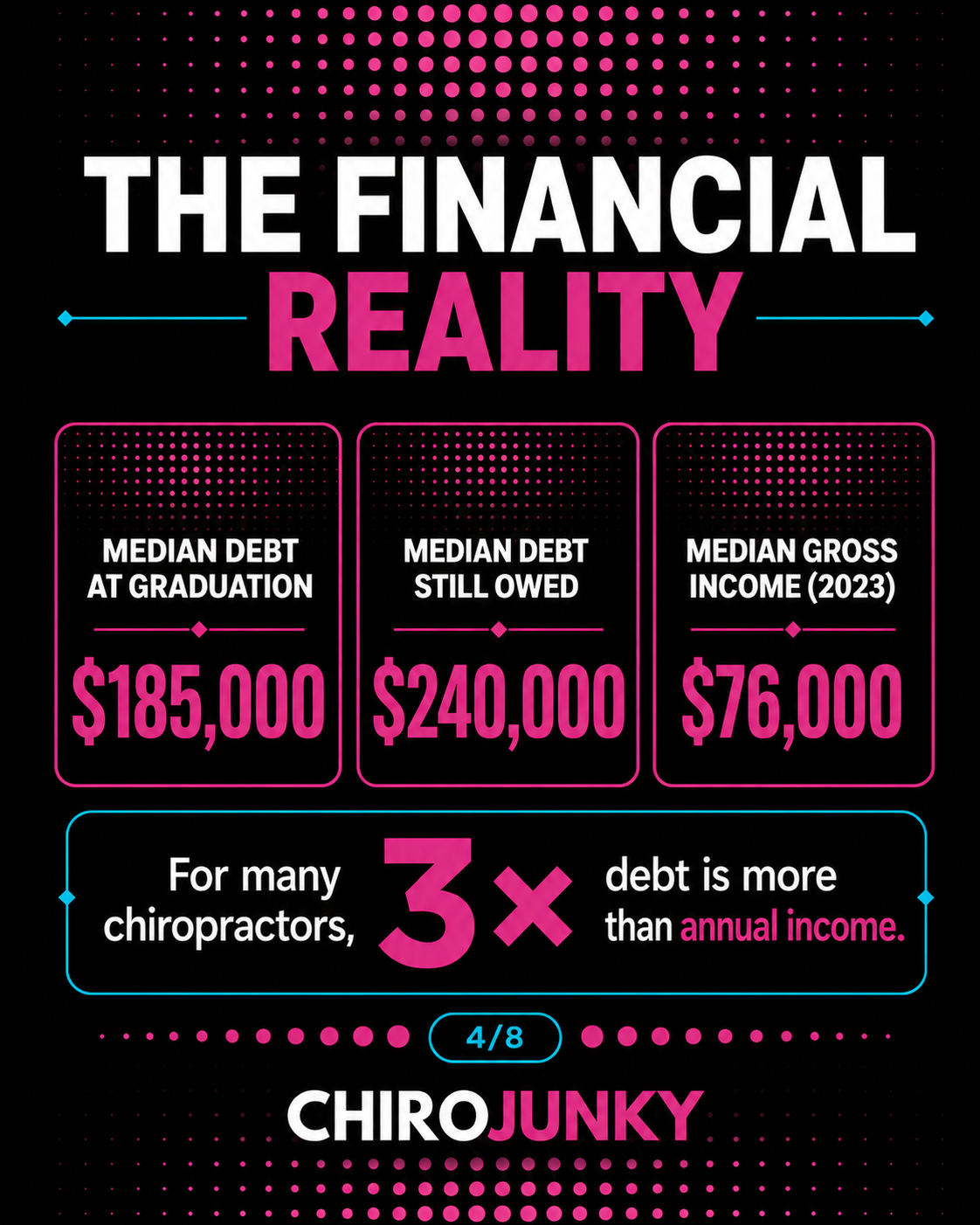
A recent national survey of U.S. chiropractors found that the median student loan debt at graduation was $185,000. At the time of the survey, the median debt still owed was $240,000. The median gross income reported for 2023 was $76,000. The study concluded that U.S. chiropractors are carrying considerable student debt that outpaces gross income.
In an analysis of more than 8,000 Student Loan Planner readers, chiropractors ranked third among the toughest professions for student loan debt-to-income ratios, behind naturopathic physicians and acupuncturists. The article noted that chiropractors had a lower debt-to-income ratio than those top two groups, but still faced real financial pressure.
If someone owes $240,000 and earns $76,000, their student debt is more than three times their annual income. That mean the borrower has less ability to buy a home, start a practice, have children, build savings, or qualify for other loans.
Chiropractic cannot afford to ignore that outside financial analysts are also identifying this profession as one of the more strained when it comes to student loan debt compared to income.
The profession is already concerned about declining enrollment, and we have to be honest about one major reason students may be hesitant. It is not because chiropractors lack passion. Many of us love this work deeply. But passion does not pay back $240,000.
The same national survey found that 53.3% of respondents disagreed or strongly disagreed that their chiropractic program provided a positive return on investment. About 70% rated the financial ROI as low or very low, and 65% said they would not choose chiropractic again.
That should stop us in our tracks.
When practicing chiropractors are financially insecure, they are less likely to recommend the profession. When fewer students enter, schools struggle. When schools struggle, tuition pressure can worsen. When the profession shrinks, we lose cultural reach, political power, and public visibility. That cycle cannot be fixed by cute marketing alone. It requires the profession to confront the financial reality graduates are living with.
Private Loans
One of the proposed responses from the ACC includes creating private lender pathways. If federal loans are threatened, schools will naturally look for alternative ways to keep students enrolled, but private lending shifts more risk onto the student and their family. Private loans may come with credit requirements, co-signers, higher interest rates, fewer repayment protections, and less flexibility if the graduate struggles financially after school.
For a profession already struggling with high debt-to-income ratios, privatizing more of the borrowing does not solve the problem. It may make the problem harder for graduates to survive. And if the profession is concerned that graduates are not earning enough to satisfy an earnings accountability rule, the answer cannot simply be to move students into loan products that may be less forgiving when those earnings are low. That is not a student-centered solution. It is a survival strategy for institutions. But for many students, it may be the very thing that closes the door.
If chiropractic education becomes harder to access for students from low-income families, the ripple effect will be felt far beyond admissions offices. Fewer low-income students entering chiropractic means fewer doctors with lived experience in under-resourced communities. Fewer doctors from those communities means fewer providers likely to build practices there, educate there, advocate there, and stay there.
We have to consider who gets pushed out when federal aid disappears and private lending becomes the backup plan.
Moving Forward
So what can the profession do?
If graduates are leaving school with debt that outpaces income, that is a problem. If doctors are financially insecure enough that they would not recommend the profession, that is a problem. If the only emergency plan is to move students into private loans with fewer protections, that is a problem. And if chiropractic education becomes less accessible to students from low-income families, the communities already most disconnected from chiropractic care will feel it first.
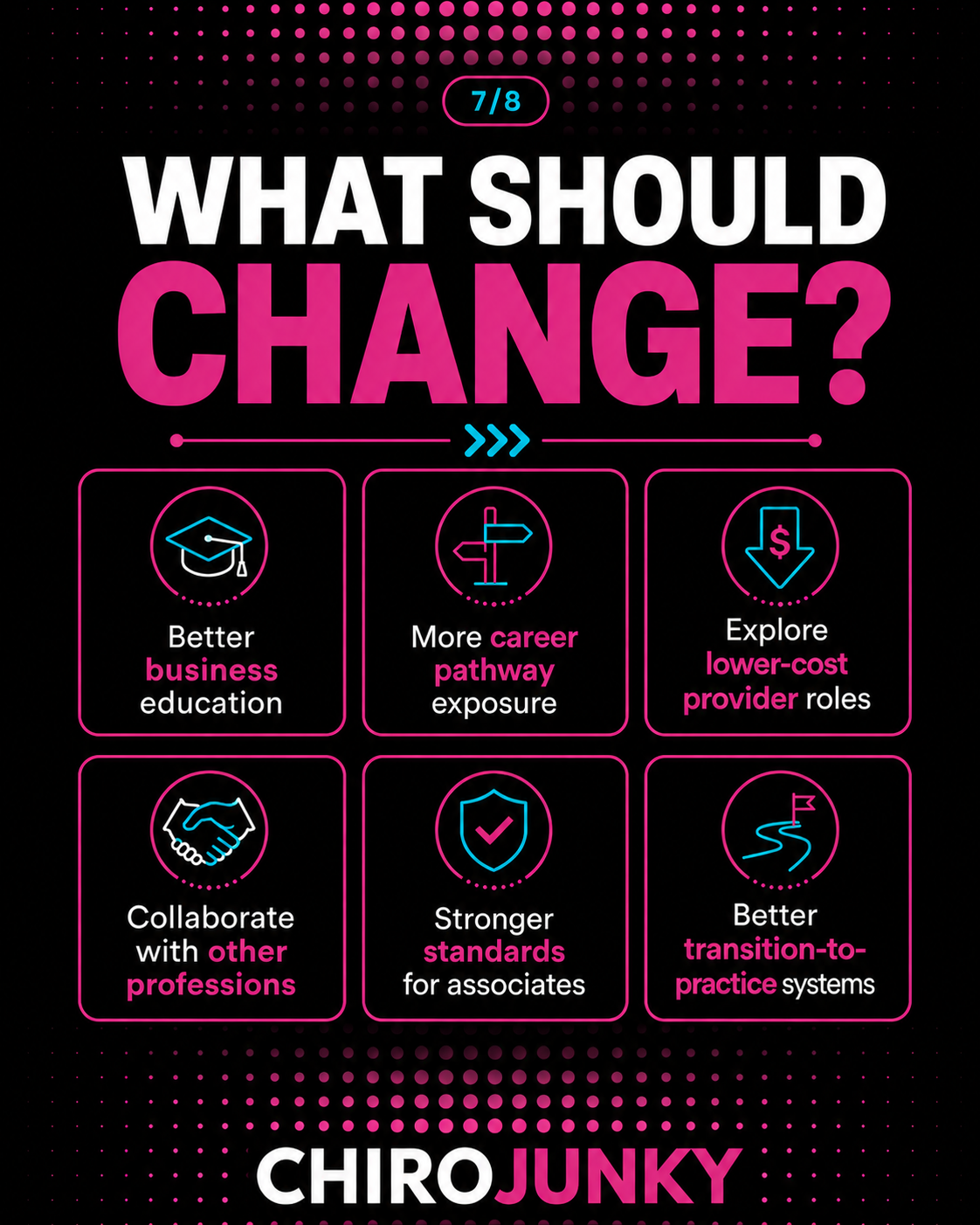
Chiropractic programs have to take business education seriously. If the profession knows that many graduates will become associates, independent contractors, clinic owners, or self-employed providers, then students need more than a few business lectures before graduation. They need real preparation in contracts, billing, coding, pricing, taxes, marketing, patient retention, leadership, compliance, payroll, insurance reimbursement, cash practice models, and practice finance. Clinical skill matters, but clinical skill without business literacy leaves new doctors vulnerable.
The profession should consider whether every person drawn to chiropractic needs to become a doctor. There may be room to explore a mid-level chiropractic provider pathway, such as a chiropractic therapist or certified chiropractic assistant with expanded hands-on skills, who can provide limited care under appropriate supervision without diagnosing. This could create a lower-cost pathway for people who want to work in chiropractic care but do not necessarily want the full responsibility, debt, or scope of becoming a doctor. It could also help expand access to conservative care at a lower price point while preserving the role of the chiropractor as the diagnosing and managing provider.
Students need to see more pathways for what a chiropractic degree can do. The profession often sells one narrow version of success: open a clinic, build a practice, and adjust patients forever. That path matters, but it is not the only one. Students should be exposed to opportunities in education, research, sports, public health, policy, consulting, corporate wellness, product development, media, interdisciplinary clinics, nonprofit work, healthcare administration, and other ways to leverage the degree. If graduates are going to carry doctor-level debt, they need to understand every possible pathway to make the degree work financially.
Chiropractic should not fight this alone. The ACC article already notes that other healthcare and wellness professions may also be affected. That matters. Chiropractic should be building a united front with acupuncture, naturopathic medicine, occupational therapy, massage therapy, cosmetology, esthetics, and other fields that are concerned about this rule.
The profession has to listen to students and young doctors. Not just invite them to the room for optics, but actually hear what they are saying. The debt burden study found that 53.3% of respondents disagreed or strongly disagreed that their chiropractic program provided a positive return on investment. About 70% rated the financial ROI as low or very low, and 65% said they would not choose chiropractic again. Those numbers are not just data points. They are a warning from the people living the outcome of the current model.
The profession needs stronger standards for associate doctors. Many graduates enter associate positions before opening their own practices, but the quality, compensation, mentorship, expectations, and protections in those roles vary widely. The profession should consider associate pay guidelines, model contracts, mentorship standards, transparent salary ranges, and even organized advocacy or union-like structures to protect early-career doctors from exploitative arrangements. If associates are the entry point for many graduates, then associate jobs must become financially and professionally sustainable.
Chiropractic schools should rethink the internship and transition-to-practice experience. Medicine has Match Day, and it has become both a placement process and a powerful marketing moment. Chiropractic already has tools like ChiroMatch, but the profession could use them more intentionally. Schools could celebrate where graduates are going, what communities they will serve, and what pathways they are pursuing after graduation. That would help students see clearer career options while also giving the public a stronger story about the future of chiropractic.
None of these solutions are simple. But the current model is not simple either. The goal is to build a model of chiropractic education that is financially honest, more accessible, and more sustainable for the students carrying the debt and the communities depending on them.
Protecting chiropractic education means more than protecting institutions.
